How Smart Is the Scanner? The Tech Behind Food Allergy Scanning Apps
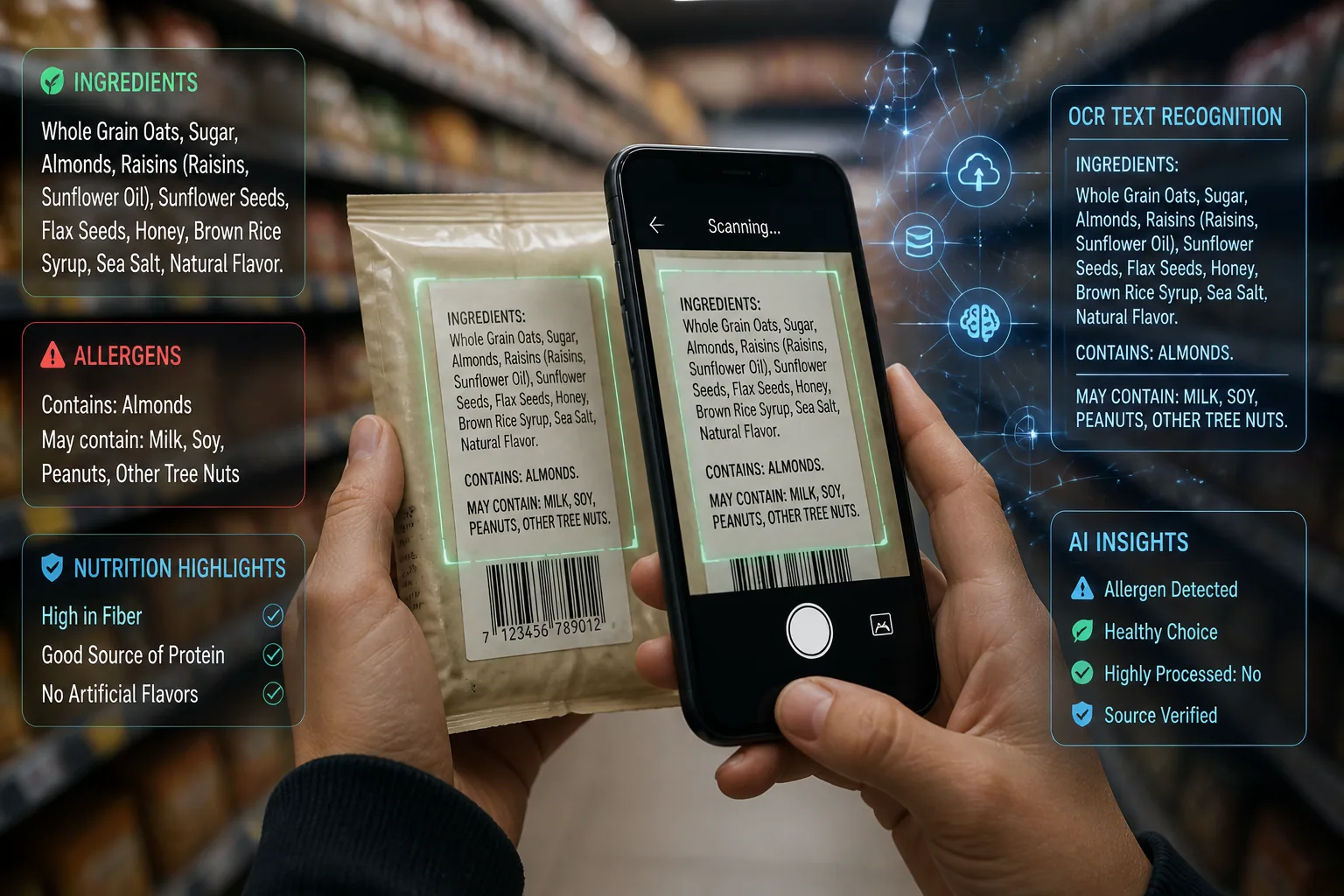
Food allergy scanning apps can feel surprisingly intelligent. You point a camera at a label, and in a second the app tells you whether a product looks safe, risky, or somewhere in between. For people managing allergies or intolerances, that kind of speed can be a huge relief in the middle of a grocery aisle.
But the real story is a bit more technical than magic. These apps are usually combining optical character recognition, natural language processing, and constantly updated allergen databases to turn messy packaging into a safety decision. And because the goal is safety, they are often designed to be cautious rather than perfectly optimistic.
Why Allergy Scanners Can Feel Smart and Overly Careful
At their best, allergy scanners do three hard things at once: they read printed text, interpret ingredient meaning, and compare that meaning against a user’s allergy profile. That is a lot to ask from a mobile phone camera.
This is why scanners sometimes seem to flag products that look harmless to the average shopper. They are not always trying to be dramatic. Often they are built to avoid false negatives, because missing a real allergen is far more serious than warning on a product that turns out to be acceptable after review. In allergy tech, caution is not a bug so much as a safety feature.
How OCR Reads Ingredient Labels in Real Time
The first major step is OCR, or optical character recognition. This is the part that turns the image of a package into machine-readable text. The app captures a label, isolates the ingredient panel, and then tries to identify every visible word, line break, and punctuation mark.
When OCR works well, it can extract the ingredient list fast enough for a near-instant answer. That is why some tools feel so smooth in practice. Independent testing of food-packaging OCR pipelines has found that systems tuned for packaged goods can reach around 94% accuracy under typical consumer shots, with most remaining errors caused by unusual layouts, artistic labels, or split panels. HalalLens also reports that specially problematic cases include light gray text on white backgrounds, curved surfaces, glossy packaging, and multilingual text mixed together. Source: https://halallens.no/blog/building-real-time-ocr-pipeline
Where OCR Struggles: Glare, Fonts, Damage, and Foreign Languages
OCR is impressive, but packaging is a messy real-world surface. Labels are often printed on curved bottles, metallic wrappers, shiny snack bags, or cartons with low-contrast text. A tiny font size can make one ingredient blur into another. A dented package or torn wrapper can cut out the exact line the app needs.
Foreign languages create another layer of difficulty. Many products have interleaved multilingual labeling, and the OCR engine has to decide where one language ends and another begins. Even good models can stumble when ingredient panels are visually crowded or when the text uses unusual spacing and stylized fonts. HalalLens specifically notes that curved surfaces, glossy packaging, low contrast, and interleaved multilingual text are serious sources of error. Source: https://halallens.no/fr/blog/the-unsolved-challenge-of-cleaning-ocr-text-from-food-packaging
There are also broader trade-offs between OCR systems. An evaluation of four open-source OCR tools on real food packaging showed that performance and coverage varied widely, especially when the layout became complex or multilingual. That means the camera is only part of the story. The choice of OCR model matters too. Source: https://arxiv.org/abs/2510.03570
How NLP Turns Ingredient Lists Into Risk Signals
Once the text is extracted, the app still has to interpret it. This is where natural language processing comes in. Ingredient lists are not written like clean database rows. They are packed with nested sub-ingredients, commas, brackets, additives, and shorthand.
NLP helps split that raw text into meaningful pieces. It can separate a parent ingredient from its sub-ingredients, identify that an additive code corresponds to a specific compound, and normalize different ways of writing the same ingredient. The FDA has described parsing ingredient lists as a way to preserve inter-ingredient relationships while building a much larger vocabulary of unique terms and synonyms across consumer packaged goods. Source: https://www.fda.gov/science-research/fda-science-forum/programmatic-approach-parsing-ingredient-lists-consumer-packaged-goods-effective-data-analysis
That matters because allergy risk is rarely about one perfect keyword match. It is about connecting the ingredient name you see on the label to the ingredient family, derived ingredient, or alternate name that a person must avoid.
Decoding Vague Terms Like Natural Flavors and Additives
Some of the hardest label terms are the vaguest ones. Phrases like natural flavors, spices, colorings, emulsifiers, or plant-based protein can hide a wide range of actual ingredients. For an allergy scanner, that ambiguity is exactly the problem.
Natural language systems can look for patterns and relate these terms to known risk categories, but they still cannot read a manufacturer’s mind. If a product says natural flavors, the scanner may not know whether the source includes an allergen unless the brand or database has more specific information. Additives and E-numbers can create the same challenge, especially because different regions and manufacturers may use different naming conventions.
This is one reason scanners often prefer to alert on uncertainty rather than ignore it. If a label is vague, the technology may flag it for review instead of assuming it is safe.
Why Allergen Databases Matter More Than You Think
OCR and NLP only get the app so far. The real intelligence comes from the allergen database behind the scenes. That database maps ingredient names, synonyms, derivatives, and warning phrases to specific allergen categories.
This is especially important because food labels are not static. Major allergen rules also change over time. In the United States, the FALCPA law requires major allergens to be declared using common names or contains statements, and sesame was added as the 9th major allergen under the FASTER Act, with mandatory labeling effective January 1, 2023. Source: https://www.fda.gov/food/nutrition-food-labeling-and-critical-foods/food-allergies
Apps that keep their databases current can catch these regulatory changes, plus the many smaller naming variations that appear in real products. That is why a scanner can feel much smarter than a simple keyword search. It is not just matching peanut to peanut. It is understanding language around food labeling.
How Real-Time Updates Catch Recipe Changes and Trace Warnings
Ingredient lists change more often than many shoppers realize. A brand may reformulate because of supplier issues, cost, seasonality, or a new recipe. That can change allergen exposure even when the packaging looks almost identical.
Real-time or frequently updated databases help catch those changes. Some tools monitor ingredient shifts across open data sources and compare old and new versions so users can see what was added, removed, or potentially introduced as a new allergen risk. That kind of update logic is especially valuable when a product is close to the edge of someone’s tolerance.
Trace and precautionary warnings also complicate the picture. In the U.S., precautionary allergen labeling, such as may contain statements, is voluntary rather than standardized in the same way as mandatory allergen declarations. Because those warnings are inconsistent, apps often have to decide how strictly to treat them. Source: https://www.fda.gov/food/food-labeling-nutrition/food-allergies
Why Two Apps Can Give Different Answers on the Same Product
If you scan the same product with two apps and get different answers, that does not necessarily mean one app is broken. The difference may come from the OCR engine, the allergen rules it uses, the freshness of its database, or how it interprets vague ingredients and trace warnings.
Some apps rely more heavily on barcode lookups and verified product records, while others depend more on camera OCR and text interpretation. In barcode-based systems, the barcode itself is usually easy to read, but the database behind the scan determines whether the result is accurate. Benchmarking of nutrition apps has shown that barcode recognition rates can be extremely high, while the real inconsistency comes from whether the product record is verified, crowdsourced, or outdated. Source: https://www.nutrientmetrics.com/guides/barcode-scanner-accuracy-across-nutrition-apps-2026
In other words, the camera is only one input. The final answer depends on how the app reasons about the product after the scan.
How Your Allergy Profile Changes What the Scanner Flags
The most personal part of the system is the user profile. A scanner is only useful if it knows what you react to, how severe your reactions are, and whether you want to avoid trace exposure or only direct ingredients.
That is why customizable profiles matter so much. A person with a severe milk allergy may want to avoid any possibility of cross-contact, while someone with a mild intolerance may only care about obvious dairy ingredients. Some users also need the app to watch for less common allergens, derived ingredients, seeds, spices, or sensitivity to additives that are not part of standard major allergen lists.
AllergIQ-style profile systems show why this matters: the more specific the profile, the more meaningful the result. An app that can combine user-specific allergies with alternative names, flavoring agents, additives, derived ingredients, and may-contain warnings will usually feel much more precise than one-size-fits-all scanning. Source: https://allergiq.org/allergy-scanner
What Too Cautious Really Means in Allergy Tech
A scanner that flags a product as risky is not necessarily making a mistake. It may be doing exactly what it was designed to do: reduce the chance of missing something dangerous.
Too cautious often means the system found uncertainty. Maybe the ingredient text was partially unreadable. Maybe the database contains an allergen synonym. Maybe there is a precautionary warning. Maybe the product has been reformulated and the app has not yet fully resolved the new version. In those cases, a conservative result is a way of telling the user to double-check before buying or eating.
For allergy management, that conservatism has real value. A false alarm is annoying. A missed allergen can be serious.
Best Practices for Getting More Accurate Scan Results
Even the best scanner performs better when the user helps it out. A few small habits can improve accuracy dramatically.
Hold the camera straight on, not at an angle. Try to avoid glare by tilting the package or moving away from harsh overhead light. Make sure the ingredient panel fills most of the frame. If the label is tiny, move closer and steady your hand. When possible, scan the ingredients panel rather than a decorative front label, because the front of the package often omits the details the app needs.
It also helps to check the language and region. Regional labeling rules differ, and ingredients may be listed differently depending on where the product was sold. If the app supports it, choose the country or market that matches the product. And if the result looks uncertain, manually reviewing the ingredient list is still the safest step.
If you want a tool built around speed and practical grocery use, Bokha: Food Allergy Scanner App is worth a look: https://findthe.app/bokha
The Future of Food Allergy Scanning: Smarter, Faster, More Personalized
The future of allergy scanning is likely to be less about one perfect scan and more about a better chain of decisions. OCR will keep improving on messy packaging, multilingual labels, and curved surfaces. NLP models will get better at mapping ingredient synonyms, additives, and vague phrases to real risk categories. Databases will become more dynamic as brands reformulate products and warning systems evolve.
There is also a clear move toward personalization. Better allergy tech will not just ask what product is in your hand. It will ask who you are, what you react to, how sensitive you are, and what level of uncertainty you are willing to accept. That is a big shift from generic food databases to truly individualized safety tools.
Research on food ingredient recognition shows there is still a gap between ideal and real-world performance, especially when lighting, occlusion, and label complexity increase. But that gap is exactly why the technology keeps getting better. Every misread label, every reformulated product, and every new synonym gives the system more to learn from. The scanner is getting smarter not because food labels are getting simpler, but because the tools behind the scan are learning how messy real life actually is.