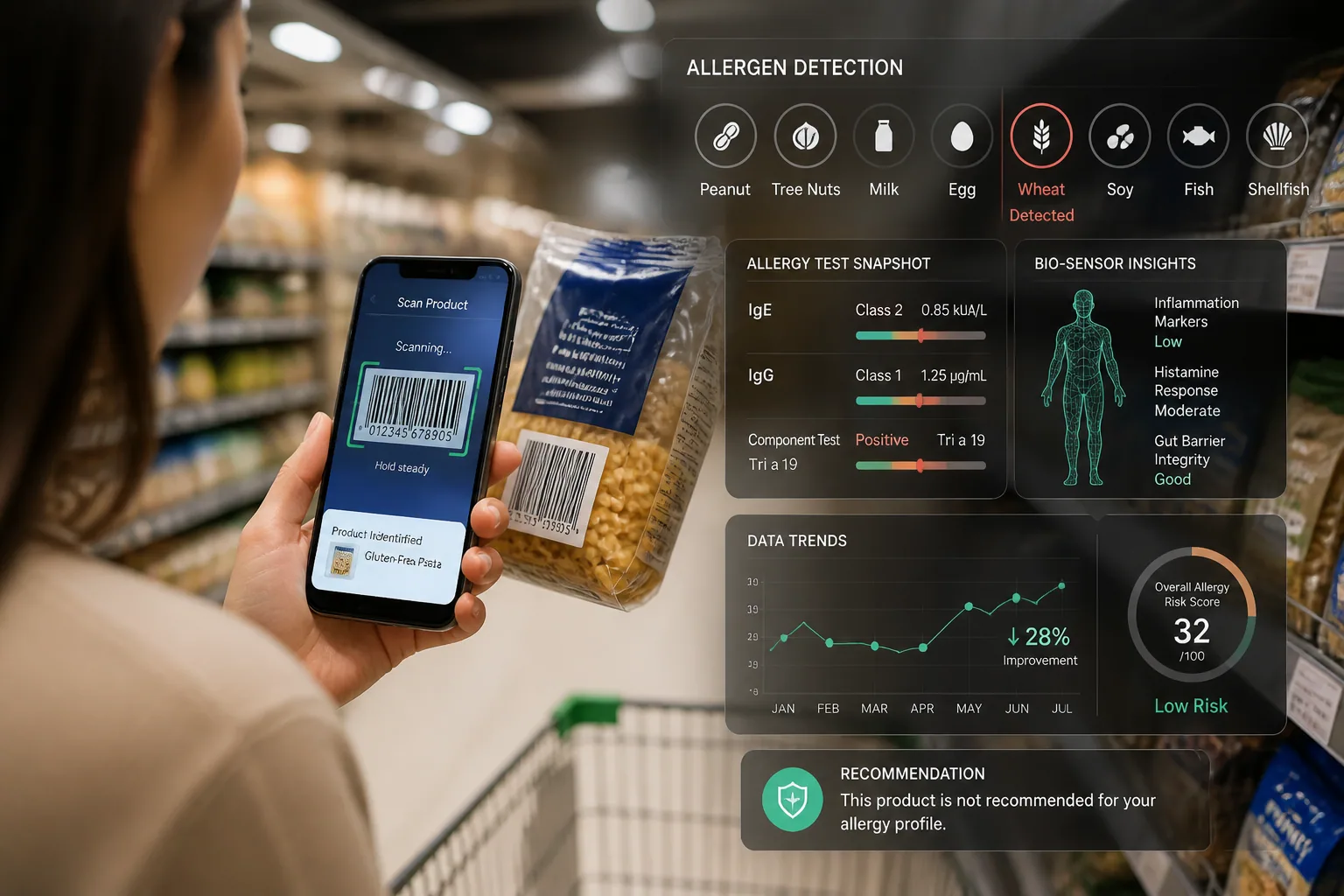
A Deeper Look at Modern Allergy Diagnostics: Smarter Testing, Faster Answers, and Safer Shopping
Allergy testing has changed a lot in recent years, and for good reason. If you are newly diagnosed with a food allergy, the first goal is usually simple: find out what is really happening, what you should avoid, and how serious the risk may be. But traditional tools like skin prick tests and standard IgE blood tests do not always give the full picture on their own. That is why newer approaches such as component-resolved diagnostics, multiplex allergen assays, and even AI-assisted interpretation are getting so much attention.
The important thing to know is this: modern allergy diagnostics are not replacing the allergist. They are giving doctors more detail, more context, and sometimes faster answers. At the same time, everyday tools like scanner apps can make life easier in the supermarket by helping you identify allergens in packaged foods. Together, these tools can make allergy management feel less confusing and more manageable.
Why Allergy Testing Is Changing So Quickly
Food allergy care is moving toward more personalized decision-making. Instead of asking only whether someone is sensitized to a whole food, clinicians now want to know which specific molecules are involved, how strongly the immune system is reacting, and whether the result matches the person’s actual symptoms. That matters because two people can test positive to the same food but have very different real-world risks.
This shift is also happening because old methods have limits. Skin prick tests and standard specific IgE blood tests are useful, but they can sometimes show sensitization without proving true clinical allergy. In other words, a test may suggest the immune system recognizes an allergen, but that does not always mean the person will react when they eat it. That is one reason follow-up evaluation is so important.
Technology is also making testing more practical. Faster laboratory methods, larger allergen panels, machine learning models, and image-based interpretation tools are all being developed to improve efficiency and consistency. Recent AI models presented at the 2026 AAAAI meeting reportedly improved diagnostic accuracy by about 40% over standard clinical criteria, with deep learning models adding another 10 to 15% improvement in AUC compared with machine learning models. That is promising, but it still needs to be interpreted carefully and used alongside medical judgment.
Traditional Allergy Tests: What They Still Do Well
Traditional allergy testing still plays a major role because it is familiar, widely available, and clinically useful when paired with a detailed history. Skin prick testing can quickly show whether the immune system reacts to a suspected allergen on the skin. Standard specific IgE blood tests can help identify sensitization without exposing the patient directly to the allergen. For many people, these tests are the starting point of an allergy workup.
Their biggest strength is accessibility. They are widely used in allergy clinics and are often enough to guide the first round of decisions. They are also valuable when the history is clear, such as when a person consistently reacts after eating a specific food and the test supports that story.
But these tests also have important limitations. A positive result does not always mean a true allergy, and a negative result does not always rule one out, especially when symptoms or exposure history suggest otherwise. That is why allergists do not rely on the number alone. They interpret the result in the context of the person, the timing of symptoms, and sometimes additional testing.
This is also why many unnecessary food restrictions happen. People may see a positive lab result and assume they must avoid the food completely, even if they have never had a reaction. In allergy care, that kind of over-interpretation can create stress, limit diet unnecessarily, and make eating feel more complicated than it needs to be.
What Is Component-Resolved Diagnostics (CRD)?
Component-resolved diagnostics, often called CRD, looks deeper than a standard whole-food allergy test. Instead of testing for one broad allergen, CRD checks the immune response to individual molecular components within that allergen. This can help clinicians distinguish between true allergy and cross-sensitization, which is when the immune system reacts to a similar protein without causing a meaningful reaction to the food itself.
That difference matters a lot. For example, in peanut allergy, specific components such as Ara h 6 have shown very strong performance in research, with sensitivity and specificity both around 95% in one cited study. For hazelnut, Cor a 14 showed similarly strong performance, with 100% sensitivity and about 94% specificity. In egg allergy, Gal d 1 has also shown useful performance, especially in heated egg testing, with around 84% sensitivity and 90% specificity at a low threshold in one analysis. These results show why CRD can help build a more personal risk profile.
The practical benefit is that CRD can sometimes help doctors decide whether a positive test is likely to represent a real food allergy or a less clinically important sensitization. That can reduce unnecessary avoidance and help focus attention on the foods that truly matter. But there is an important caution: even though CRD is more specific for certain cases, no CRD cutoff has consistently matched the oral food challenge gold standard in both sensitivity and specificity across all situations.
So CRD is powerful, but it is still a tool for decision-making, not a final verdict. It helps narrow uncertainty, not eliminate it completely.
How Multiplex Allergen Assays Give a Broader View
Multiplex allergen assays take a different approach. Instead of checking one allergen at a time, they test many allergens or molecular components at once from a small blood sample. This can be especially useful when a patient has complex symptoms, multiple suspected triggers, or a history that does not point clearly to just one culprit food.
One big advantage is efficiency. Multiplex testing reduces the amount of sample needed, speeds up analysis, and can lower reagent costs compared with repeated single tests. In cases where a patient would otherwise need many separate IgE measurements, multiplex testing may save time and provide a broader overview in one step.
Research also suggests multiplex CRD can be cost-effective in the right setting, especially when it replaces numerous single sIgE tests in difficult-to-manage allergic disease. A 2018 systematic review found that although the upfront cost may be higher, the overall cost per useful diagnostic finding can drop when multiplex testing prevents scattered, less efficient testing patterns.
The key phrase here is in the right setting. Multiplex testing is not always necessary for straightforward cases. But when the picture is messy, broad testing can reveal patterns that would otherwise stay hidden.
Where AI-Powered Allergy Testing Fits In
AI in allergy diagnostics is still emerging, but it is already showing how technology can support clinicians. One area is image interpretation. Tools such as SkinSight AI by ModuleMD were highlighted at AAAAI 2026 as a way to automatically interpret skin prick wheals from images, which may reduce manual measurement errors and subjective differences between observers.
That kind of support matters because skin test reading is not always perfectly consistent. Small differences in measuring a wheal can change interpretation at the margins. If a digital system can standardize that process, it may improve workflow and reduce variation between clinicians or clinics.
AI is also being explored for more advanced decision support. According to recent meeting reports, machine learning and deep learning models improved diagnostic accuracy compared with standard clinical criteria. That does not mean AI can diagnose food allergy by itself. It does mean it may help sort data more effectively, spot patterns across multiple tests, and support more informed decisions.
For patients, the takeaway is simple. AI may soon make allergy testing faster and more consistent, but it does not remove the need for a specialist to interpret results in context.
Home Test Kits vs. Point-of-Care vs. Lab Testing
This is one of the biggest areas of confusion for people trying to understand allergy diagnostics. Home test kits, point-of-care tools, and laboratory-based tests are not all equal, even if they sound convenient.
Home kits are often marketed as simple and fast, but many of them measure IgG or IgG4 rather than IgE. That is a problem because IgG often reflects exposure or tolerance, not true allergy. Health sources caution that these results can lead to unnecessary food avoidance, and that many home kits have high false positive and false negative rates. Without a proper medical history, they can be misleading.
Point-of-care diagnostics sit somewhere between home testing and full lab work. They can be useful when speed matters, and they may help clinicians get quicker information during an appointment or in a specialized setting. However, they still need proper validation and clinical interpretation. A fast result is not automatically a more reliable result.
Laboratory testing remains the most established approach for IgE-based diagnostics, CRD, and multiplex assays. It is generally more rigorous, more standardized, and easier to interpret in combination with medical history. If you are trying to make long-term decisions about diet and safety, lab-based evaluation is usually the most trustworthy place to start.
In practical terms, convenience and accuracy often move in opposite directions. Home kits may be easy to use, but they can be unreliable. Lab testing takes more effort, but it is far more useful for real medical decisions. Point-of-care tools can improve speed, but they are not a shortcut around good clinical reasoning.
The Biggest Questions to Ask Before Trusting Any Test
Before putting too much weight on any allergy result, it helps to ask a few basic questions. What exactly is being measured? Is the test looking at IgE, IgG, or a specific molecular component? Has this method been validated against real clinical outcomes? And how does the result fit with your own history of symptoms?
Another important question is whether the test tells you anything actionable. A result is only useful if it helps guide safer eating, smarter avoidance, or a follow-up plan with a clinician. If the answer is simply that you are sensitized to many things without clear meaning, then the test may create more confusion than clarity.
You should also ask about false positives and false negatives. No test is perfect, and the more a result depends on context, the more important expert interpretation becomes. A good allergist will not just hand you a lab report. They will explain what the numbers may mean, what they do not mean, and whether more testing is needed.
How to Read Allergy Test Results Without Jumping to Conclusions
This part is especially important for people who are newly diagnosed. It is very easy to see a positive result and immediately think, “I can never eat this again.” But allergy testing does not work that way. Sensitization and clinical allergy are related, but they are not always the same thing.
A stronger result can sometimes suggest a higher likelihood of allergy, but it still does not tell the whole story. For example, CRD can help identify components that are more associated with true reactions, yet even then, severity cannot be predicted perfectly from the test alone. A person may have a positive component result and still need an oral food challenge or more history before the diagnosis is confirmed.
It also helps to remember that numbers do not exist in isolation. A low positive result in someone with no reaction history is very different from a similar result in someone who has had immediate symptoms after exposure. The clinical story matters as much as the lab work.
If you are unsure how to interpret a result, pause before making major dietary changes. Talk to an allergist, ask what the result actually changes, and whether it should alter your daily behavior now or simply guide the next step in evaluation.
When You Should See an Allergist
You should see an allergist if you have had symptoms that suggest a food allergy, such as hives, swelling, vomiting, coughing, wheezing, throat tightness, or dizziness after eating. You should also seek specialist care if you have unexplained reactions, multiple suspected triggers, or results from testing that do not match your symptoms.
An allergist is especially helpful when you need a careful diagnosis rather than a guess. They can decide which tests are worth ordering, interpret results in context, and determine whether your case needs CRD, multiplex testing, or a more traditional approach. This is also the right person to discuss emergency planning, avoidance strategies, and whether an epinephrine prescription is appropriate.
If you only have a family history of allergy but no symptoms, testing may not be necessary immediately. If you have already started avoiding foods based on a home test or an online panel, that is another good reason to get professional guidance, because you may be restricting foods you could safely eat.
Why Follow-Up Testing, Including Oral Food Challenges, May Be Needed
Even with advanced diagnostics, follow-up testing may still be necessary. The oral food challenge remains the gold standard for confirming food allergy because it directly evaluates whether a person actually reacts to the food under medical supervision. That makes it especially valuable when blood tests or skin tests show sensitization but the clinical story is unclear.
This matters because no lab test can perfectly predict all reactions, and no component result can fully replace real-life exposure testing in a controlled setting. If the result is mixed, if the history is uncertain, or if the stakes are high, an oral food challenge may be the best way to clarify the diagnosis.
Challenges can sound intimidating, but they are often the most definitive way to avoid unnecessary long-term restriction. In some cases, they can also show that a food is tolerated after all, which is a huge relief for patients and families.
The main message is not that testing is unreliable. The message is that testing works best as part of a step-by-step process, where each result informs the next decision.
How Bokha’s Scanner App Complements Allergy Testing
This is where Bokha fits in naturally. Bokha is not a diagnostic tool, and it should not replace allergy testing or an allergist’s advice. What it does well is make everyday shopping safer and faster by helping you scan packaged products and identify allergens in less than a second.
That kind of support is extremely useful once you already know what you need to avoid. Bokha can detect 13 allergens, including lactose, gluten, peanut, egg, soy, fish, shellfish, tree nuts, wheat, mustard, celery, mint, and sulphites, along with traces and additives such as colorants and preservatives. For many people, that means less time reading labels and more confidence in the grocery aisle. You can learn more here: https://findthe.app/bokha
The best way to think about a scanner app is as a daily management tool. Medical testing helps define the allergy. Bokha helps you live with that information more easily. It does not decide whether you are allergic, but it can help reduce the stress of checking ingredients one product at a time.
In that sense, it complements modern diagnostics perfectly. The allergist helps answer the question, “What is my true risk?” The app helps answer, “Is this product safe for me right now?”
Building a Smarter, More Confident Allergy Management Plan
The future of allergy care is not one single test. It is a smarter system that combines detailed medical evaluation, advanced lab methods, careful interpretation, and practical day-to-day tools. Traditional testing still matters because it gives the foundation. CRD adds molecular detail. Multiplex assays widen the view. AI may improve consistency and speed. Scanner apps help with real-world decisions after the diagnosis is made.
For people newly diagnosed with food allergies, that layered approach can feel reassuring. You do not need to understand every molecule on day one. You just need a plan that tells you what is confirmed, what still needs checking, and how to stay safe while you learn.
If you are unsure about your results, if your symptoms and tests do not match, or if you are considering major diet changes, the safest next step is to see an allergist. And if you already know your allergens, tools like Bokha can make everyday shopping simpler, faster, and more confident.